Saturday, 31 October 2015

Yarn bundling - the knitted results

In my previous post, I showed the resulting yarn of my first attempt at yarn bundling. The colours of the various natural dye stuff are applied very locally on the skein, which gives a vivid colouring in patches spread all over. Now, I knitted up this first skein, and the cuffs and half mittens are lovely. The colours are really autumnal, which I love, warm, and the colours spread about the knitted item as well as in the skein. Remember my remark that perhaps the skein was a little dry so that the colours only spread minimally. This resulted in yarn with still an amount of white left. First, I'll show you the cuffs. A very simple pattern to let the yarn colouring show the best:
Next are the fingerless mittens. Usually I knit with thinner yarn, so this time it was a really quick knit. A simple ribbing and stockinette stitch was enough to make the half mitts become beautiful, cosy, practical accessories:

Saturday, 10 October 2015

Bundling - natural dyeing of yarn

Bundling is the name for a technique where one dyes a fabric by wrapping it tight together with dyeplants and heats it or leaves it a few days in a warm place.


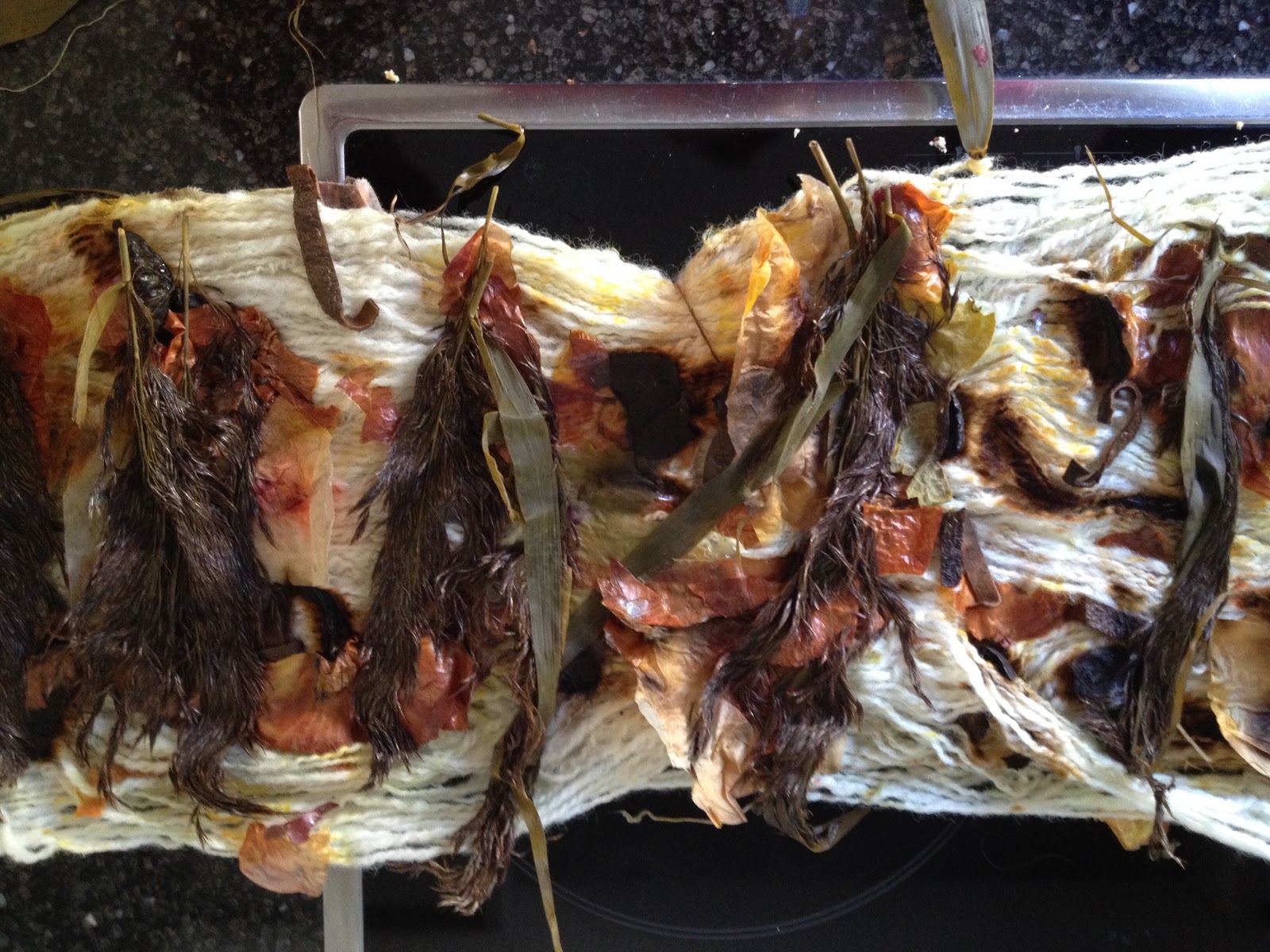
I have done the same but with my handspun yarn. You wrap the pre mordanted, moist/wet yarn together with dyeplants in a bundle, heat it (I did it in the microwave but originally you steam it), leave it to cool (I left it 4-5 days in a big glass jar so that it remains humid), unwrap and wash/dry it. This was new to me and I tried it with walnut, onion, reed, some madder and sandelwood.

I used a lot of plant material, on and betreen the strands of yarn, and also, when the bundle was all rolled up, I put an outer layer of reed plumes (is it called reed plumes?) to wrap around.

As I was afraid that small stuff would attach to the yarn and would be difficult to remove, I put the madder and sandlewood in paper teabags, just a little bit in each bag, and laid it out on the skein. But actually everything fell out quite easily afterwards, no onion flakes or walnut peel crumbs were left so there was no need to worry.

The microwave was my idea as I do not have steaming equipment and when dyeing with acid dyes one can use the microwave: 3 minutes on (max effect), 7 minutes rest, and this sequence repeated 3 times, so 30 minutes in total.

I found that the dried plant materials soaked up quite a lot of moisture that was in the yarn, and thought that, next time, either the yarn must contain more water when starting, or steaming would be better. With a little more moisture, I believe that the colour spreads a little bit wider away from the plant material. So now I found a metal sieve at a thrift store and plan to steam for the next experiment. Steaming would be done for an hour or so.

An advantage of steaming above the microwave is also that you can add some rusty parts, to do after-treatment with iron to influence colour. Yellow from onions turns green with iron. I would not dare to put skrews and bolts in the microwave, but one can include some in the bundle when steaming.

I also believe that the result is so striking because of the dark brown from the walnuts. They are really super for this method! My walnuts are gone but for next year I am already thinking to put some in the freezer. So if you still have access to walnut shells, and want to do this bundling somewhat later in the year, e.g. with spring or summer plants, put some aside!

Here you see how I put all the dye stuff in the skein and wrap it. You can also see that the whole package is wrapped in reed plumes at the outside.


This is how it looked when I unwrapped it.


And with all the plant material removed, before and after washing. You still see the spots in the skein where the various dyestuff was wrapped, especially the walnut!


And lastly, when re-skeined into a fresh skein.

Friday, 18 September 2015

Hello dear friend

Today I will show you something that was completed several years ago and something else that was created today.

Two years ago, I worked with ceramics. I enjoyed it a lot, and still miss it sometimes. However, time constraints make that I have not touched clay since then. Last weekend however, I went to visit the studio where my old teacher  is giving classes nowadays, and where she had an exhibition going on. When she saw me, she said: I have something that is yours... And she went to fetch this little friend of mine, which had been sitting and waiting patiently all that time. I had forgotten all about this sheep and was really surprised and very happy to see it and take it home. It has such a friendly expression on its face!


Today I completed a band weaving project of a pickup pattern from Föllinge. It was the first pickup pattern inkle for me, and the beginning was quite complicated. After a while I found out how to read the pattern and how to pick up and drop threads as per the pattern. It was a bit different from the videos I had watched on rigid heddle band weaving, as the warp threads ly so close in my inkle loom, where the rigid heddle really spreads the warp out so you can se the lowered part of the warp through the lifted part.

The pattern is from a blog by a Swedish woman, publishing some patterns from a collection of patterns from a certain part of Sweden, Jämtland. Föllinge is a village in the western part of Jämtland, not far from the Norwegian border. Hannas website can be found here: hannakristine.se.

Wednesday, 1 April 2015

Broderade muddar - Embroidered cuffs

Hej igen,

English below.

Det har varit en fasansfull storm under 1,5 dygn. Igår blåste taket från ett flervåningshus, välte en lastbil på motorvägen, och blåste fönstret in hos min man på jobbet i det nya fina kontoret de flyttade till i höstas. Tåget var ur funktion på många sträckor, men lyckligtvis inte på 'min' sträcka mellan jobb och hem.

Just nu skiner vårsolen, och det ser nästan ut som om vädret/naturen säger: Vem? Jag? Nää, jag har inte gjort något!

Under tiden stickar jag vidare, det är fler muddar som blev klara, redan för ett tag sedan, denna gång med broderi på, vilket är nytt för mig, men så roligt.

Första paret är gjort med restgarn. Garnet är inte restgarn 'som blev över efter ett stickproject', nej, det är gjort på rest-singlar, entrådiga bitar som blev över efter tvinnandet när det andra entrådiga tog slut. Dessa entrådiga snuttar, ibland rätt mycket, spar jag på tre udda spolar och när det finns tillräckligt så blir det ett finfint tretrådigt garn.
Det är stickat med 'linnestickning', linen stitch på engelska, och broderiet är gjort med ett rosafärgad gotlandsgarn som också donerade en bit till det tretrådiga garnet (kan ni se det?). För övrigt finns en härlig mix av ullsorter i garnet: gotland, dorset, blå texel, leicester longwool, värmlandsfår mm.

Det andra paret är stickat på gotlandsgarn, i storlek jättestor. Sedan är muddarna tvättade i tvättmaskinen för att filta sig. Avigsidan blev snyggare än rätsidan så den fick bli finsidan, som det blev broderi med Isländsk tema på. Isländska magiska tecken, där den nedersta ska målas på en trätunna och skyddar mot läckage, den valde jag mest för formen, och den översta bringar bäraren tur i handel och affärer. Broderigarnet är tunnt kamgarn på Leicester Longwool.

English. Two pairs of cuffs, knitted of my handspun, both with embroidery, which is new to me. Well, embroidery isn't new, but I haven't done it on knitted items yet. Such fun!

The first pair is knitted in linen stitch. It is an easy knitting stitch which you can find instructions on the tube, simply knit 1, lift 1 with yarn in front, repeat. Make sure you have an uneven number of stitches. The yarn is spun from singles which were left over after plying, stored on three spare bobbins and plied together when full. The embroidery is mainly done with a pink gotlandyarn of which a single is in the knitting yarn as well. The pattern is a fantasy pattern.

The other cuffs are knitted and then felted in the washing machine. The purlside was nicer so that became the outside. The embroidery is done with a combed and worsted spun Leicester Longwool. The signs are old Icelandic magical signs. The lower one was usually put on a wooden barrel to prevent it from leaking, and the upper one brings the bearer good fortune in commerce and business.

Saturday, 28 March 2015

Skudde garn/yarn

Skudde är en fårras som härstammar från öst Preussen, Litauwen och Schweiz. Nuförtiden finns smågrupper Skudde i Tyskland och Nederländerna, och också i andra länder men det finns inte många.


Min Skudde ull är från en liten grupp får i Nederländerna som hålls för att ägaren skall kunna träna sina vallhundar, Skudde får är snabba och håller bra ihop så därför är det bra träningsfår. De är enkla att hålla, kräver inte mycket skydd, kan vara ute hela vintern och är inte kräsna med maten. De används ofta som landskapsvårdare.


När jag fick fällen blev jag förskräckt över hur mycket märghår det fanns, korta, svarta, stickiga hår som i och för sig kunde plockas ut lätt men eftersom det fanns så mycket så var det ändå ingen ide att försöka. Den hade inte så mycket, gråbrunt, täckhår och otroligt mjuk underull i en vacker ljusgrå färg. Ullen har legat nästan ett år, jag fick den i Maj 2014, tvättade den och visste sedan inte vad jag skulle göra med den. Men nu har jag tagit fram en del, kardade den ik kardmaskinen till rullar (4 rullar per kardflor), och spann ett löst spunnet tvåtrådigt garn. Det blev trevligt, mycket luftigt av den mjuka underullen. Härvan på bild är spunnen av 2 lätta kardflor, straks under 50 gram. Märghåren finns, så det begränsar användningsområdet, men jag ser en liten stickad väska med axelrem av ullen famför mig.

English. Skudde is a rare breed of sheep with its origin on the east Preussian region, Lithuania and Switzerland. Nowadays there are small groups of these sheep in Germany and the Netherlands, as well as in other countries but their are not many of them.

My Skudde fleece is from the Netherlands, of a small group of sheep that is kept to train the sheepdogs of the owners. They are active, quick sheep to train with. They are easy, low maintenance sheep, hardy and not picky in the food they eat. Often they are kept for maintenance of an open landscape.

The fleece contains a lot of brittle kemp, så much that it is impossible to remove, e.g. by combing. The outer hair is grey and brown, the wool part is so soft and of a beautiful light grey. I drumcarded part of it in two thin cardfleeces, parted each in 4 rolags and spun a low twist two-ply yarn. Actually quite beautiful. The kemp is making usage for garments a bit difficult but I see a small bag with long shoulderband as apossibility.

Wednesday, 25 March 2015

Sittdynor - Sitting pad

För bra länge sedan spann jag några rejäla garn. Ett grått och ett svart gotlandsgarn och ett vitt från Veluws Heideschaap. Det sista garnet är från en gammal holländsk ras som brukade användas att beta på ofruktsam hedelandskap. Fåren samlades på natten och deras spillning togs tillvara för att göda åkrarna. Fåren har alltså aldrig selekterats på ullkvaliten och ullen är full av märghår. Det sticks men framförallt kommer dessa hår alltid att fällas ur vad man än gör med garnet. Så det skulle användas till något oömt och där det inte gör något att vita hårda hårstrån faller ut.

Det blev en sittdyna. Stickat med ett mönster ur en stickbok och filtad i tvättmaskin.
English. A long time ago I spun yarn from Veluws Heideschaap, an ancient Dutch breed that was kept to graze on unfertile soil and to stay in a barn overnight so that their manure could be gathered and used as fertilizer on the farmers fields. The sheep were never bred for the wool and their fleece is full of kemp. This kemp will fall out of anything made with it, slowly and unstoppable. So if you don't want white brittle hairs everywher on your clothes or on the sofa, you cannot knit garments or a pillowcase of it. I decided to make a sitting pad which I felted in the washing machine. This was the result and I like it very much. So does my husband who uses it when he has to work in a very chilly office every week.

Mönstret blev något suddigt men jag blev mycket nöjd med resultatet. Min man använder den när han skall sitta och arbeta på ett kallt kontor, som händer en dag i veckan och han är också jättenöjd.

Jag fick mera ull från Veluws Heideschaap och har nu garn till ytterligare en sittdyna. Så den stickar jag på nu. Mönstret och övergångarna i färg är lite bättre planerade och jag ser fram emot att vi får var sin sittdyna, som vi kan ha när vi är på utflykt, i trädgårdsstolarna eller helt enkelt hemma på köksstolarna.


English. I received more Veluws Heideschaap, spun another thick yarn and started knitting another one. Unfortunately I don't recall the exact thickness of the yarn, nor the needle size used. A miracle has to happen in the washing machine to end up with two sitting pads of similar size.

Jag minns inte riktigt vilken stickstorlek jag använde och det kan hända att garnet inte har samma tjocklek, det sparade jag inte och är svårt att se på ett filtat objekt. Men det måste hända ett under i tvättmaskinen om dessa två skall bli lika stora.


Wednesday, 25 February 2015

Birds paradise /Fågelparadiset

En promenad i ett landskap där vinter håller på att övergå i vår. Människor dämde upp platsen för länge sedan, för att tillgodose sina egna behov. Nu har fåglarna fått tillbaka området och de använder det gärna. För att häcka, för att vila, hitta föda eller för att sova över. Ljudet av överflygande gäss förkunnade att våren är inte långt borta.

This bit of land was once dry, used by farmers. Now it has been returned to the wildlife, the birds. They use it happily to rest, to eat and to build their nests. The geese that flew over called out loud that spring is on its way.